
Does Tesamorelin Help You Build Muscle?
Does Tesamorelin build muscle? The honest answer is that Tesamorelin will not build muscle for you unless you are doing your part: eating enough high-quality protein, digesting it well, and consistently lifting weights. When you put resistance against your muscles, you stimulate protein synthesis; Tesamorelin is a catalyst that can enhance that process, not a replacement for it.
This article explores what Tesamorelin is, what clinical research has shown, how it affects visceral fat, liver health, metabolic markers, cognition, and muscle quality, and how it is often stacked with other peptides to support body composition and performance.
What Is Tesamorelin?
Tesamorelin is a growth hormone–releasing peptide (technically a growth hormone–releasing factor analog). It was studied extensively around 2010, particularly in patients living with HIV. Many of these patients were in an immunocompromised state and were taking medications that caused large increases in visceral adipose tissue (VAT)—the deep, metabolically harmful fat that surrounds internal organs.
Clinicians recognized that as these patients lost muscle mass, their insulin regulation worsened, pushing them toward diabetes and chronic inflammation. Visceral fat accumulating around organs also led to cirrhotic, scarred, fibrotic livers that struggled to process toxins and nutrients. Patients were caught between the disease and the side effects of treatment.
Peptides like Tesamorelin were introduced as a way to help modulate body composition—reducing visceral fat and restoring muscle—in an effort to improve long-term outcomes.
What Studies Found
In the HIV population, researchers compared a group taking Tesamorelin to a control group not receiving the peptide. Tesamorelin acts on the pituitary gland to stimulate the release of growth hormone, which in turn supports deep sleep, muscle preservation, joint health, and a more youthful appearance. As we age, our endogenous growth hormone and related signals decline rapidly.
In these studies, researchers measured IGF-1 (insulin-like growth factor-1), a key marker closely tied to growth hormone activity and often used as a “longevity and vitality” metric. Many patients had IGF-1 levels comparable to those of 80- or 90-year-olds, sometimes so low that they met criteria for growth hormone deficiency.
The hypothesis was straightforward: if they could increase growth hormone via Tesamorelin, they might help patients build or preserve muscle. More metabolically active muscle tissue could then demand more energy, draw on fat stores, and improve overall metabolic health.
Results over six months showed a 15–20% reduction in visceral adipose tissue. Over two years, researchers observed another striking effect: fibrotic livers, in some cases up to 90% damaged, showed reversal of fibrosis and improved function in patients using Tesamorelin.
These outcomes supported the approval of Tesamorelin under the brand name Egrifta. It became an FDA-approved peptide for HIV-associated lipodystrophy, and today it is also prescribed off-label by some clinicians for broader metabolic and body composition support.
Stacking Tesamorelin with Other Peptides
In practice, Tesamorelin is often stacked with other peptides. One common combination is Tesamorelin with ipamorelin. Ipamorelin works via the ghrelin pathway, while Tesamorelin works as a growth hormone–releasing factor analog; together, they can produce a higher pulse of growth hormone—often five to seven times greater than baseline.
In HIV patients and other individuals using Tesamorelin, many reported greater cognitive clarity, better information retention, and an enhanced ability to build muscle. Meanwhile, in the control groups without Tesamorelin, body composition stayed poor, blood sugar remained dysregulated, and triglycerides and lipids remained elevated.
In those taking Tesamorelin, triglycerides dropped, total cholesterol decreased (especially LDL), and overall metabolic profiles shifted toward those expected in someone 10 years younger. IGF-1 levels often rose above 200, which is more in line with youthful physiology. This gave patients a better chance to control their disease without sacrificing quality of life.
Safety, Cost, and Practical Considerations
Clinical trials have shown that patients tolerated daily Tesamorelin doses up to 2 mg for as long as two years. However, the brand-name drug is expensive—often around $3,000 per month—which puts it out of reach for many. Compounded versions from specialty pharmacies can be significantly cheaper, sometimes around 80% less, but still represent a meaningful investment.
Because of this, Tesamorelin makes the most sense for people who are already committed to nutrition and training. If you are not eating properly, not prioritizing protein intake, and not exercising—especially resistance training—you will not get the full benefit. Tesamorelin is a trigger, not a magic solution.
Some clinicians and biohackers also discuss stacking Tesamorelin with a myostatin inhibitor such as ACE-031. ACE-031 is designed to inhibit myostatin, a natural “brake” on muscle growth, thereby opening another pathway for building muscle. The idea is that a weekly ACE-031 injection turns down the brakes, while Tesamorelin, used five days per week with two days off, stimulates the growth hormone and mTOR pathways to promote muscle hypertrophy. Human clinical trial data on the specific combination of ACE-031 and Tesamorelin are lacking; much of the enthusiasm is based on personal experiments and anecdotal clinical experience.
How to Use Tesamorelin More Effectively
For growth hormone–releasing peptides to work effectively, insulin levels need to be low. That is why they are typically used in a fasted state—about 90 minutes after your last meal. Many people find that dosing before bed works best, both to align with natural growth hormone pulses and to minimize awareness of mild side effects such as flushing or immune system reactions that can occur with some peptides (for example, CJC-1295).
Using Tesamorelin first thing in the morning while fasting is another option, but whichever schedule you follow, the key is keeping insulin low during and after injection for optimal effect.
Just as important is your training schedule. You will see better results if you exercise—especially on the days you use the peptide. Without consistent training, the impact on muscle growth and fat loss is greatly reduced.
Diet is also critical. High intakes of seed oils, ultra-processed foods, and insufficient protein can sabotage progress. You cannot “out-peptide” a poor lifestyle. Tesamorelin works best when layered on top of solid habits: whole foods, sufficient protein, resistance training, sleep hygiene, and stress management.
Clinical Outcomes and Benefits
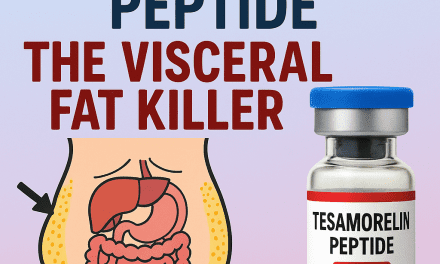
A New England Journal of Medicine study on growth hormone–releasing factor analogs found that Tesamorelin use produced, on average, a 15% reduction in visceral adipose tissue. This is especially important because VAT is metabolically inert and inflammatory: it disrupts hormone signaling, promotes chronic inflammation, and drives further fat storage via pathways such as NNMT.
By reducing visceral fat, Tesamorelin helps restore healthier metabolic signaling, improves muscle quality, and supports healthier body composition. Many people refer to Tesamorelin as the “fat melter peptide” because of its pronounced effect on abdominal fat.
For those looking to enhance athleticism, build more muscle, move more freely, sleep more deeply, think more clearly, and look leaner and healthier, Tesamorelin may be a tool worth discussing with a qualified medical professional.
Where to Start
The logical starting point before considering Tesamorelin is comprehensive blood work, including IGF-1 and other metabolic markers. From there, a practitioner can help determine whether growth hormone–related peptides are appropriate. Some clinics offer additional educational material, including downloadable books and guides, to help people understand how peptides fit into an overall health strategy.
As with any hormone-related therapy, Tesamorelin should be used under proper medical supervision, with realistic expectations and a commitment to lifestyle changes. Peptides can be powerful catalysts—but the foundation will always be your nutrition, training, sleep, and daily habits.
This article is for informational purposes only and is not medical advice.