
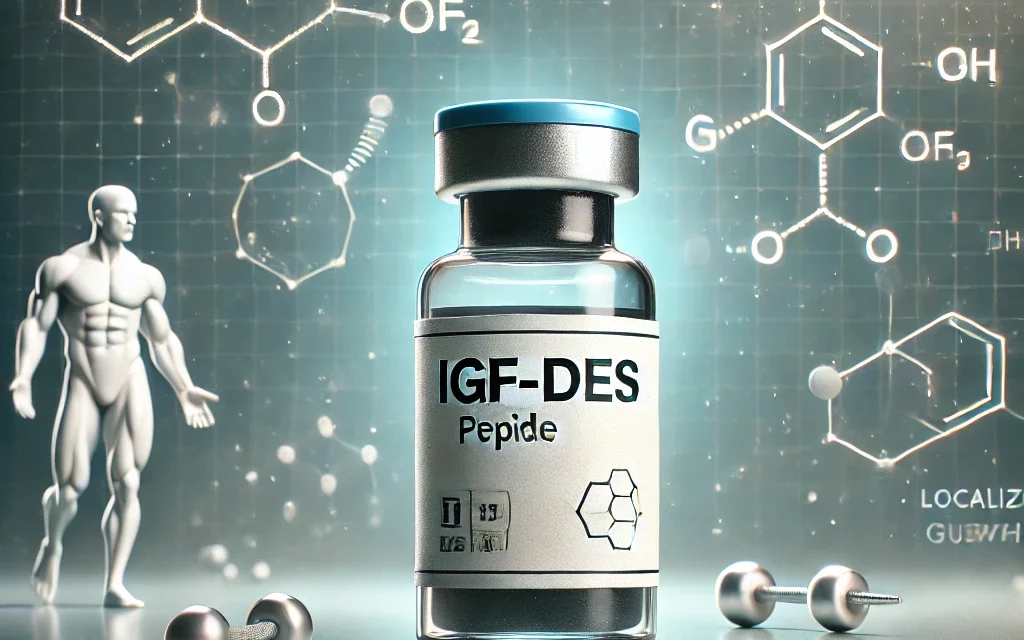
IGF-DES Peptide Profile
Category: Peptide Hormone
Chemical Name: Insulin-Like Growth Factor-1 Des (IGF-DES)
Molecular Structure: A truncated form of IGF-1, lacking the first three amino acids at the N-terminus, enhancing its bioactivity.
Mechanism of Action
IGF-DES is a variant of Insulin-Like Growth Factor-1 (IGF-1) designed to have a more potent and localized effect on tissues. By removing the first three amino acids, IGF-DES exhibits reduced binding to IGF-binding proteins (IGFBPs), allowing it to act more freely and efficiently in stimulating growth and repair. With a shorter half-life than IGF-1 LR3 (approximately 20-30 minutes), IGF-DES is best suited for immediate and localized effects at the injection site.
Benefits
- Localized Muscle Growth: Ideal for site-specific injections to enhance growth and repair in targeted muscles.
- Enhanced Recovery: Accelerates repair of damaged tissues, particularly after workouts or injuries.
- Increased Anabolic Activity: Promotes protein synthesis and prevents protein breakdown, supporting lean muscle development.
- Improved Glucose Uptake: Enhances glucose utilization in muscle cells, providing energy for growth and recovery.
- Fat Metabolism: Stimulates lipolysis, aiding in fat reduction and improved body composition.
Dosage and Administration
Typically administered via subcutaneous or intramuscular injection at the desired site. Dosages range between 50-150 mcg per day, divided into multiple injections. Due to its short half-life, timing injections post-workout maximizes its localized effects.
Side Effects
- Hypoglycemia: Increased glucose uptake may lower blood sugar levels.
- Injection Site Discomfort: Localized irritation may occur.
- Growth of Non-Target Tissues: Risk of unintended tissue growth with improper administration.
Legal Status
IGF-DES is considered a research chemical and is not approved for human use outside of research settings. Its use is banned in competitive sports by most regulatory organizations.
Conclusion
IGF-DES offers potent and localized anabolic benefits, making it an effective tool for site-specific muscle growth and recovery when used responsibly.
IGF-DES Peptide Profile
Read the other protein peptide profiles by clicking here
THIS IGF-DES PEPTIDE INFORMATION IS FOR BOTH ADULT MALES AND ADULT FEMALES.
| Peptide Profile: IGF-1 DES (IGF-DES) | Category | Example Amount per Use* | Frequency* | Typical Cycle Length* | Notes |
|---|---|---|---|---|---|
| Adult Males – Experimental Use | Research / performance, localized tissue studies | Very low doses in the low tens of micrograms per injection (for example a small number of mcg per site) are the kind of ranges commonly discussed in research and bodybuilding forums, but there is no standardized, medically approved dosing protocol for cosmetic or performance use. | Often described as once daily or limited to training days only in informal sources; in proper clinical or lab settings, timing and repetition are set by the supervising professional or research protocol, not by the subject. | Short experimental “blocks” are usually kept to a few weeks at a time, then stopped and reassessed; long continuous use has not been well studied and carries more unknown risk. | Male users in non-medical settings often try to target muscle, tendon, or localized tissue, but this is outside approved indications. Any use aimed at physique or performance is essentially self-experimentation and carries risk to insulin sensitivity, growth pathways, and long-term health. |
| Adult Females – Experimental Use | Research / performance, localized tissue studies | Similar very low microgram-level dosing is typically referenced for females, but with an even stronger emphasis on starting at the absolute low end due to generally smaller body size and hormonal differences. Any escalation should only occur in a medical or formal research context. | Informal sources describe once-daily or pre-training patterns, but again, there is no official, sex-specific human dosing standard. Responsible clinicians, when they use IGF-pathway agents at all, individualize everything based on labs, risk factors, and goals. | Cycles are usually kept short and conservative, with ample off-time to observe any delayed effects on blood sugar, menstrual patterns, or general well-being. | Females can be more susceptible to shifts in glucose handling, water retention, or hormone-related side effects. Because IGF signaling intersects with growth and cancer biology, unsupervised experimentation is especially high-risk. |
| Both Sexes – Timing & Administration Context | Subcutaneous injections in theoretical, research, or performance settings | Total daily quantity is usually split into small microgram injections, sometimes divided between one or more areas, but in all legitimate environments, the exact protocol is written by a physician or research team and is not self-designed by the subject. | Timing is often aligned with training sessions or at a consistent time of day in anecdotal reports. In medical or lab settings, timing is chosen to match the outcome being studied (for example, tissue repair vs. metabolic effects). | Short-term use (often 2–4 weeks) followed by an off-period is more common than continuous long-term exposure, because chronic overstimulation of growth pathways is a theoretical risk. | Injection technique, needle choice, and site rotation all matter for safety. Poor technique can cause infection, scarring, or unpredictable absorption. Research-grade products are not manufactured to the same standards as approved medications, which adds contamination risk. |
| Both Sexes – Cycles, Breaks, and Combinations | Overall planning | Many people who experiment outside of medical supervision will keep IGF-DES cycles brief and then remain off for an extended period to see what, if any, changes persist and whether side effects appear later. | Frequency is often tapered or reduced at signs of side effects such as hypoglycemia symptoms (shakiness, sweating, confusion) or excessive localized fullness or pain. | Off-periods at least as long as the on-period are a common informal pattern, but there is no evidence-based “safe” schedule for cosmetic use. | IGF-DES is sometimes discussed in combination with growth hormone, GHRPs, or other anabolic strategies; stacking multiple growth-axis compounds amplifies both potential effect and potential harm, especially for blood sugar control and long-term cancer risk. |
| Both Sexes – Safety & Monitoring | What to watch | Any dizziness, shakiness, sweating, rapid heartbeat, confusion, or visual changes may indicate issues with blood sugar and demands immediate medical attention. | Injection-site redness, warmth, hard lumps, or spreading pain can signal infection or local tissue injury. | Changes in hands, feet, jaw, or facial structure over time, or new numbness/tingling, can be red flags related to growth-axis over-activation or nerve compression. | Users who proceed under physician supervision are typically monitored with fasting glucose, A1c, IGF-1, and sometimes imaging or cancer-screening appropriate for age and risk. Without this kind of monitoring, you are “flying blind” with a powerful growth-related pathway. |
| Both Sexes – Contraindications & Caution | High-risk situations | History of malignancy, pre-cancerous lesions, strong family history of hormone-sensitive cancers, uncontrolled diabetes, or significant organ disease are all major red-flag situations in which growth-axis agents are generally avoided. | Pregnancy, breastfeeding, and adolescence are periods when growth-signaling pathways are already active and delicate; self-experimentation with IGF-related peptides here would be particularly dangerous. | People taking insulin, sulfonylureas, or other medications affecting glucose have higher risk of bad interactions. | Any use should be considered high-risk without a doctor who understands both endocrinology and oncology risk. |
| Both Sexes – Storage & Product Quality | Handling | IGF-DES powders and solutions are typically kept refrigerated according to compounding or manufacturer instructions, protected from light. | Reconstituted solutions usually have a short shelf life and must be discarded if cloudy, discolored, or contaminated. | Using “research only,” non-pharmacy sources brings unknown dosing accuracy, sterility, and impurity concerns. | Legitimate, human-grade preparations are tightly regulated in real medical environments; anything else is essentially uncontrolled experimentation. |
*All amounts and patterns above are high-level, example ranges drawn from how IGF-DES is discussed in experimental and performance contexts. They are not standardized medical dosing and not a recommendation to use this peptide in any way.
⚠️ Warning: This chart is for general educational purposes only and this is not professional advice or a personal dosing guide. IGF-DES is a powerful experimental peptide that affects growth and insulin-like pathways. Never start, stop, or change any peptide, hormone, or performance-enhancing protocol without a qualified healthcare provider who understands your full medical history and can monitor you appropriately.


